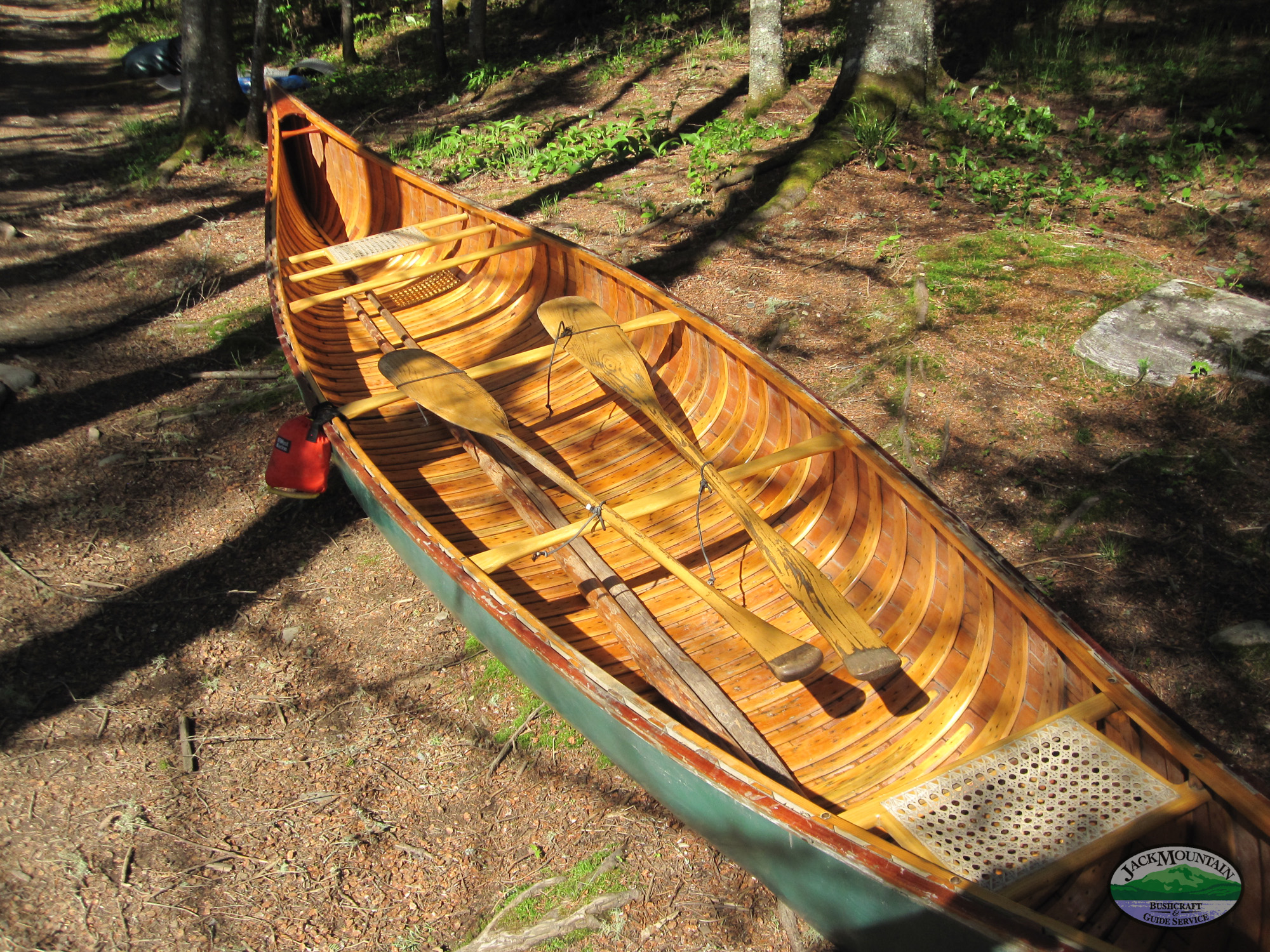
It’s week five of the spring Wilderness Bushcraft Semester and yesterday, May 4th, we put canoes on the water for the first time. In early spring the water and the air are cold. This, combined with learning to pole canoes, is often a recipe for people taking unplanned swims. So during years where the cold lingers, we try and stall until we get some warm days to make these swims less hypothermia-inducing. We always have a plan for how to get people warm if it happens, but it’s good for morale if it isn’t too cold. Once people have some experience it isn’t as much of a big deal, but for the initial few excursions on the water, it’s good to have goldilocks weather; warm sun, mild temperatures and not a lot of wind.
We place a lot of emphasis on the canoe as the method of travel in the north woods. In this part of the world, the canoe as we know it came into existence with the transition from the archaic to the ceramic period, marked by the shift from dugout canoes to birch bark canoes, which took place a little over three thousand years ago. Our modern canoes have changed some of the construction materials, but the finished craft have changed little. A stone-age craft elegant in its simplicity, available to carry a person and their belongings over vast distances with minimal effort. When you realize that a reasonably fit person in an appropriately-sized canoe with some skill and experience is able to transport 1000 pounds of people and stuff across the water, you begin to understand why it was a main source of transportation.
I’ve spent many hours watching water from river and lake shores. Every now and then a natural object floats by and I wonder if a similar floating object inspired those early boat builders. It isn’t a big intellectual leap to see how sticks and logs could inspire dugout canoes and rafts. But what launched the idea for the birchbark canoe? I’ve watched leaves float by on the surface of the water and wondered if maybe it was one of them. It’s probably a bit too whimisical and was more likely a bark vessel that was used for transporting and rock boiling water. But inspiration is often multifaceted, and maybe a floating leaf inspired the bark bowl that held water that inspired someone to think of a larger, reinforced basket that became the canoe. I’ll never know, but I still wonder.
Today we’ll start poling on the pond, then head up to a nearby lake for our initial foray into paddle practice, which will be preceded by a discussion about biomechanics and trimming the boats for wind and current, and a lot of other factual, nuts and bolts stuff. But maybe while we’re going through our catalog of paddle strokes and maneuvers in order to get our crew ready for the upcoming remote river trip, a leaf will float by on the surface of the water. And maybe a similar leaf, years ago, inspired the whole thing.